
“Trust but verify” is an excellent motto. But in the world of enterprise AI decision-making—whether you are routing high-intent sales leads, scoring credit risk, or automated-rejecting job applicants—we face a quiet crisis.
When automated systems disappoint us, the default corporate reaction is to double-down on training, spot-check a few dashboard outputs, or plead for “better model adoption”. But this misdiagnoses a fundamental model quality problem as a human behavior problem.
The truth is, most enterprise AI stacks suffer from two massive design flaws that break the critical handoff between machine intelligence and human judgment:
- Before the decision: The machine acts as an opaque black box, displaying high-confidence numbers (“Priority Score: 87”) without showing its homework.
- After the decision: When a human expert spots a mistake and overrides the machine, their context is thrown in the garbage. The system records the override as a silent, context-free click.
The result? The machine remains blind, and the human is muted.
To close this “checkability gap,” we need to build two core structural layers into every decision engine: an upfront Evidence Layer and a downstream Decision Forensic Log. Here is how they work in practice.
Part 1: The Upstream Evidence Layer (What the Machine Shows)
When a model flags an insight, we usually deliver a score. But a score is just a number wearing a lab coat. If a human sales rep, underwriting officer, or collections agent cannot interpret why the computer reached that conclusion, they will default to their own judgment.
Trust isn’t built on faith; it’s built on traceable evidence.
Let’s look at a real-world B2B Go-To-Market example: an automated engine alerting a sales representative at Navan (the business travel and expense platform) that a major target account—Enbridge—has massive buying intent.
In a traditional “black-box” system, the rep gets a notification: “Enbridge Intent: High (87%).”
If the rep has been burned by stale or false-alarm notifications in the past, they develop a “trust deficit”. They assume this is another keyword mismatch—perhaps a news article about a town in Ireland named Navan, or a historical search term. They ignore the notification, and the expensive AI investment quietly becomes shelfware.
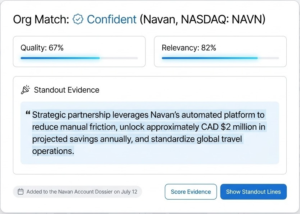
An Evidence Layer solves this by decomposing the recommendation into four verifiable elements:
1. Robust Entity Resolution (Org Match)
A computer finding the word “Navan” is a keyword match. A computer proving that the article is about their company, Navan (NASDAQ: NAVN), partnering with their target account, Enbridge, is entity resolution. Proving this upfront removes the rep’s immediate skepticism of a “false alarm.”
2. Disentangling Quality vs. Relevancy
Quality and relevancy are entirely different questions. A beautifully written, 2,000-word corporate press release might have 100% “quality,” but say nothing useful about buying intent (0% relevancy). Conversely, a messy, one-line industry blurb might contain the exact hiring or partnership signal that matters (100% relevancy). Scoring these separately tells the human exactly what kind of signal they are dealing with.
3. Interactive Receipts (Standout Lines & Score Evidence)
Reps do not have time to read a 1,500-word press release. Instead of asking them to trust the machine’s summary, the UI gives them two clickable options:
- Show Standout Lines: Surfaces the exact sentences from the source document that triggered the signal: “Strategic partnership leverages Navan’s automated platform to reduce manual friction, unlock approximately CAD $2 million in projected savings annually…”
- Score Evidence: Displays the underlying model logic and ruleset used to grade those sentences.
4. The Temporal Stamp
“Added to the Navan Account Dossier on July 12”. By anchoring the signal to a specific date and document, we defeat the dynamic data-decay problem. The rep knows exactly when this signal was captured and where it lives.
Part 2: The Downstream Decision Forensic Log (How the Human Responds)
An Evidence Layer builds trust upfront by showing the machine’s homework. But what happens when the human looks at the evidence and says, “The computer is wrong”?
In most enterprises, the rep simply clicks “decline” or “override”. The system registers the action, but because it doesn’t capture the why, the human’s specialized real-world context is thrown in the garbage.
Let’s shift to a high-stress, back-end servicing example: a collections and loan servicing agent at a credit union handling a hardship “skip-a-pay” request.
The Opaque Path
The collections AI reviews the borrower’s hardship request. It scans a thin, spotty 90-day payment history and recommends decline.
However, the collections rep gets the borrower on the phone. They hear a shaky voice, but they also get critical context the machine structurally could not see: the borrower just started a new job, and their income stabilizes next Friday.
The rep overrides the AI and approves the skip-a-pay. But because the software doesn’t support a forensic logging mechanism, the system records this as a silent click. Six months later, the account cures successfully. Was the AI wrong, or did the rep just get lucky? No one can answer, because the override was recorded as a transaction, not a data point.
The Forensic Log Path
A Decision Forensic Log ensures that human overrides are captured as structured feedback to improve the model. At its core, every log entry must capture:
- Inputs the AI actually had: Thin 90-day payment history, account tenure, delinquency flag.
- Inputs the AI structurally lacked: Verbal phone call context (employment change).
- The human’s validated reasoning: Employment change verified verbally by the rep.
- The downstream outcome to track: Does this account cure in 60 days, or does it re-delinquish?
By logging these elements, we can plot every override onto a 2×2 Matrix divided into four distinct quadrants:
- Accurate: The machine was correct, and the human followed its recommendation.
- Noisy: The machine had the right inputs but produced inconsistent recommendations based on minor data fluctuations.
- Blind-Spotted: The machine’s recommendation was technically logical based on its data, but it lacked critical real-world signal that the human was able to collect.
- Lucky-but-Fragile: The machine made the right recommendation, but based on weak or flawed reasoning that would break under a slightly different case.
In our collections scenario, this override is a classic Blind-Spotted event. The machine didn’t fail; it was simply blind to the phone call. Identifying this tells the engineering team exactly what the machine needs: we don’t need to rebuild the model; we need to build an integration that ingests or transcribes verbal phone call logs into the data foundation.
Closing the Loop
The goal of enterprise AI is not to replace human judgment, nor is it to force humans into blind compliance. The frame that actually works is AI as the first draft, human as the editor.
The machine excels at scanning, matching, and scoring at a scale no human can match. The human excels at contextual judgment, verbal relationship building, and real-time timing instincts.
But when the machine’s reasoning is hidden, and the human’s overrides are silenced, this collaboration completely breaks down.
By building an Evidence Layer upstream and a Decision Forensic Log downstream, we turn transactions into an auditable conversation. We stop guessing why our systems are failing, and finally start building automated operations that are genuinely checkable.
Want to run a diagnostic on your own automated systems? We help companies perform deep AI Trust Audits to uncover the silent data rot starving their pipelines. Let’s connect to build your checkability blueprint.
Subscribe to our newsletter