
The No-Code Automation Choice for Enterprises.
Every business leader faces the same fundamental tension: you know automation is key to efficiency, cost reduction, and scaling. But implementing it often feels like a choice between complex, resource-intensive development and overly simplistic, rapidly expensive tools.
Your enterprise is unique. Your challenges — from managing complex compliance workflows to standardizing cross-departmental approvals and integrating a sprawl of existing software — demand more than a quick fix. You need a solution that empowers your teams, ensures security, and delivers measurable ROI without demanding a new IT department.
You’ve heard the buzz around “no-code.” You might even be exploring options. But for the serious decision-maker, the choice isn’t always clear. Let’s cut through the noise and directly compare the paths before you.
🔀The Automation Promise: A Fork in the Enterprise Road
No-code automation promises to bridge the gap between operational vision and execution capability, saving millions in lost efficiency and compliance risks. But when you look at the most talked-about tools, you often find yourself at a fork in the road:
- The “Easy Start, Hidden Cost” Path (e.g., Zapier)
- The “Powerful, But Technically Demanding” Path (e.g., n8n)
- The Strategic Third Way: Enterprise-Grade No-Code (Kelsa)
Let’s explore each.
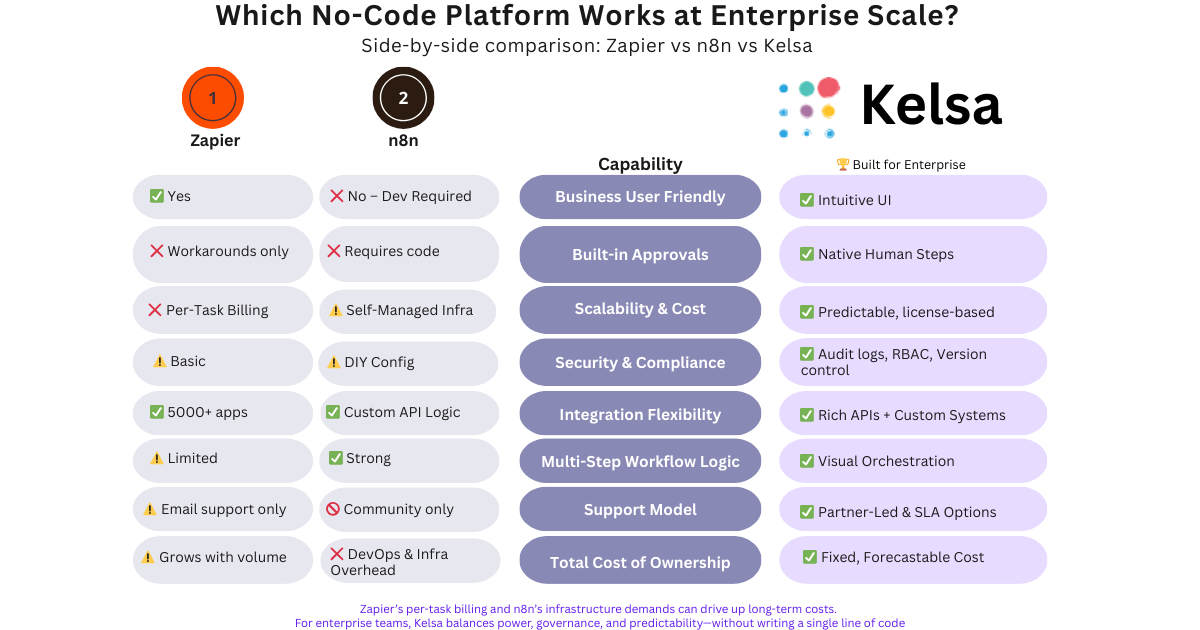
Path 1: The Zapier Lure – Simplicity at a Soaring Price
What it is:
Zapier excels at connecting thousands of apps with simple “if this, then that” automations. It’s user-friendly, cloud-based, and fantastic for individual users or small teams needing quick integrations.
🚧 The Enterprise Reality Check:
- Scalability & Cost:
For mid-to-large enterprises dealing with high transaction volumes or multi-step, multi-department workflows, Zapier’s per-task billing can quickly become unpredictable and compounding. What starts as “hundreds of tasks” often scales into millions across departments—especially when each approval or sub-process triggers its own chain of automations. Without central monitoring or cost controls, it becomes difficult to forecast automation ROI. - Complexity & Orchestration Limits:
Zapier is designed to automate discrete tasks, not orchestrate multi-stage business processes. It lacks native support for human approvals, staged workflows, or conditional routing based on user inputs. Workarounds (e.g., email+form loops or third-party tools like Airtable) exist, but they become brittle and hard to maintain. There’s no pause/resume logic, decision-based branching, or role-aware task queues—critical features for enterprise-grade process orchestration. - Hidden TCO:
Beyond usage fees, there’s the operational cost of managing dozens (or hundreds) of similar automations with no version control, modularity, or reusability. As teams build parallel flows, organizations end up duplicating effort and accumulating automation debt—with no governance layer to standardize or optimize. - Governance & Compliance:
Zapier isn’t designed with enterprise-grade audit trails, access controls, or approval visibility. There’s limited ability to restrict access by role, track field-level changes, or enforce compliance policies. Security-conscious industries often need to wrap Zapier flows in additional controls—adding overhead and friction.
Bottom Line:
Zapier is excellent for point solutions and isolated automations—but it’s not built for orchestrating end-to-end enterprise workflows with people, policies, and scale in mind.
Path 2: The n8n Promise – Unbridled Power, Untamed Complexity
What it is:
n8n is an open-source, powerful workflow automation tool that uses a node-based visual interface. It offers immense flexibility, can integrate with virtually anything (including custom APIs), and can be self-hosted—giving you full control over your data.
🚧 The Enterprise Reality Check:
- Technical Lift Required:
While often marketed as “no-code,” n8n requires a strong technical foundation for setup, troubleshooting, security hardening, and scaling. It’s not designed for business users—it’s a DevOps-friendly power tool. In practice, business teams still rely on IT, reintroducing the same bottlenecks automation was meant to eliminate. - Steep Learning Curve:
Visual doesn’t mean intuitive. Building logic-heavy flows with n8n often feels like scripting, and debugging node-by-node can be time-consuming. Enterprises hoping to democratize automation will find adoption stalling outside of technical teams. - Human Orchestration Gaps:
Like Zapier, n8n lacks native support for “human-in-the-middle” use cases. There’s no embedded approval UI, role-based work queues, or SLA-based flow logic. For workflows involving review, escalation, or conditional approvals, additional dev work or external tools are required—introducing fragility. - Total Cost of Ownership (TCO):
While n8n is open source, ownership isn’t free. Hosting it securely, scaling for uptime, and maintaining integrations often requires a dedicated team or cloud spend. Enterprises also bear the burden of compliance (RBAC, audit logs, backups), and if problems arise, there’s no SLA-backed support unless you buy into the commercial edition.
Bottom Line:
n8n offers immense power and freedom—but at the cost of accessibility, support, and sustainable ownership for non-technical teams.
The Strategic Third Way: Kelsa – Operational Excellence, Unlocked.
This is where Kelsa stands apart. We understand that enterprise decision-makers need a solution that balances the ease of no-code with the power, scalability, and security demanded by complex organizations.
Kelsa is purpose-built for the enterprise seeking true operational excellence:
- No Code, Enterprise Power:
Empower business users and process owners to create sophisticated, end-to-end workflows—no IT tickets, no code. Kelsa isn’t just about task automation—it enables process orchestration. With intuitive human intervention points, approvals, rejections, escalations, and handoffs become seamless and policy-compliant. - Predictable Scalability, No Bill Shock:
Kelsa’s architecture avoids per-task pricing entirely. Whether you’re automating 500 or 5 million steps, your costs remain predictable—allowing you to scale without fear of budget volatility. - Deep Integration, Seamless Connectivity:
Robust APIs, connectors for ERPs, CRMs, HRIS, and legacy systems ensure you’re not locked out of critical systems. Kelsa helps you eliminate tool sprawl—not contribute to it. - Human-Orchestrated Automation:
Unlike Zapier or n8n, Kelsa supports human-in-the-loop logic natively. Need approvals with routing based on amount, SLA timers, or manager hierarchy? Need review steps, policy warnings, or audit comments? It’s all built-in. - Governance & Compliance by Design:
Kelsa includes field-level audit trails, role-based access, version control, and change tracking. Every action is logged, visible, and secure—meeting the demands of regulated industries and enterprise governance teams. - From Vision to Blueprint:
We don’t just give you software—we partner with you. From automation opportunity discovery to ROI prioritization, we co-design workflows that reduce cost, streamline approvals, and unify process governance across your org.
🏁 Kelsa is for the enterprise that wants:
- ✅ To eliminate the costly gap between operational vision and execution
- ✅ To empower business users without sacrificing IT control or security
- ✅ To achieve significant cost reduction and efficiency gains, predictably
- ✅ To transform employee and customer experiences by streamlining every interaction
Stop choosing between simplicity that breaks the bank, and power that demands an engineering degree.
Your enterprise deserves a strategic partner in automation.
Ready to transform the way you work?
Discover how VorkSake & Kelsa can be your blueprint for scaling operational excellence and putting an end to endless toolsets, approval bottlenecks, and compliance headaches.
Kelsa is distributed in the USA by VorkSake LLC.
Subscribe to our newsletter